 Smartify
Why Your Business Is Invisible When Someone Asks an AI
Ask an AI to recommend a company in your category and most businesses never appear. Why answer engines miss you, and the checks you can run this afternoon.
Ask ChatGPT to recommend a company in your category and see what comes back. For most businesses the answer is unflattering in a particular way: it isn’t that you rank badly, it’s that you don’t appear at all. Not lower down. Absent.
That’s a different failure from a bad search ranking, and it has different causes. Worth understanding before anyone sells you a fix — much the same way it is worth knowing what actually changes about a team’s work before buying AI training.
Answer engines don’t work like search engines
Three differences matter, and they compound.
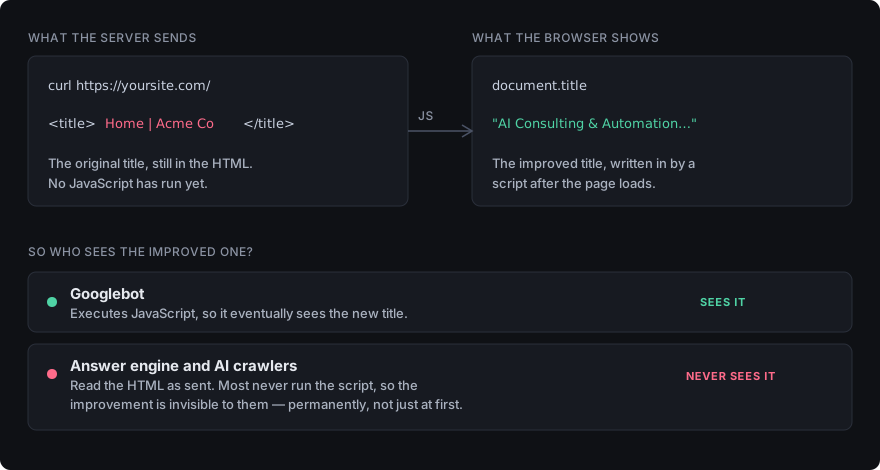
Most of them don’t run JavaScript. Google’s crawler executes the scripts on your page and sees the result. Almost nothing else does. If your page title, description, or key content is written in by JavaScript after the page loads, a search engine eventually catches up and an answer engine never does. It reads whatever the server sent, which may be an empty shell.
This catches more sites than you’d expect, because a whole category of SEO tooling works by injecting improvements client-side. The dashboard shows green. The crawler sees nothing.
They quote rather than list. A search engine gives ten links and lets the person choose. An answer engine composes a paragraph and cites a handful of sources. There is no page two. Being the eleventh-best page on a topic used to be worth something; now it’s worth nothing at all.
They lean heavily on corroboration. A claim that appears only on your own website is a claim from an interested party. The same fact appearing on your site, your business profile, a directory, and in a review someone wrote is a fact the model will repeat. This is why businesses with thin external presence stay invisible no matter how good their site copy is.
The checks worth running yourself
Before hiring anyone, you can establish most of the picture in an afternoon.
Fetch your own page the way a simple crawler does. In a terminal:
curl -sL https://yoursite.com/ | grep -o '<title>[^<]*</title>'If that returns something different from what you see in the browser tab, your metadata only exists after JavaScript runs, and most AI crawlers are not seeing it.
Ask the engines directly. Open ChatGPT, Claude, Perplexity and Google’s AI mode, and ask each the question a customer would actually ask — “who does X in my area”, “what’s a good company for Y”. Note whether you appear, what they say about you, and who does appear. That last part is the most useful and the part people skip.
Check what a machine can establish about you without your website. Search your business name and see whether the basic facts — what you do, where, how to reach you — are consistent everywhere they appear. Inconsistency doesn’t just look untidy; it gives a model competing versions and it will often use neither. The same question pointed inward is what decides whether an internal assistant can answer anything useful.
What actually moves it
Put your metadata in the page itself. Not injected, not layered on. If a tool is improving your titles and descriptions at render time, that improvement needs to end up in the source or it isn’t reaching the crawlers that matter most here — which is the distinction an AI SEO engagement should be making on your behalf.
Answer real questions in full. Content written to hit a keyword produces text that circles a topic without ever stating anything quotable. Content written to answer a question produces sentences a model can lift. Read your own page and ask which sentence an AI would quote. If there isn’t one, that’s the problem.
Be honest about limits, publicly. Pages that say when something isn’t a good fit get cited more than pages that claim everything. Models are trained on text where hedged, specific claims are more reliable than absolute ones, and it shows in what they surface.
Get the corroboration. A complete business profile, consistent listings, and reviews with actual sentences in them — the unglamorous half of being found locally. Reviews matter more here than most people realise — a star rating is a number, but a review that describes what you did is text a model can quote back to someone asking.
Fix the plumbing. If your domain has dead URLs from an old site, return 410 rather than 404 so they’re retired faster. If old pages linger with content that no longer describes you, they’re competing with your real pages for the model’s attention.
What to expect
Slower than search, and lumpier. Search rankings move incrementally; AI visibility tends to sit at nothing and then appear, because you cross a threshold of corroboration rather than climbing a ladder. Anyone giving you a week-by-week projection is guessing.
The number that matters is not traffic. It’s whether the engines mention you, and whether what they say is accurate. Both are measurable, and measuring them monthly is more useful than any ranking report.
When this isn’t worth doing
If your customers don’t research before buying — emergency work, pure walk-in trade, contracts won by relationship — the effort is better spent elsewhere, often on answering the calls you already get. Ask how your last ten customers found you. If none of them started with a question typed into anything, this is not your bottleneck, and finding out where the bottleneck really sits is the more useful piece of work.
If your website doesn’t yet say clearly what you do and who for, fix that first. Making a vague site more legible to machines produces a machine-readable vague site.
And if you have no reviews and no external presence at all, start there rather than with content. The corroboration problem is upstream of everything else, and it’s the cheapest thing on the list to fix.
The short version
Answer engines mostly can’t run JavaScript, they quote instead of listing, and they trust facts that appear in more than one place. So: get your metadata into the page itself, write things worth quoting, say plainly what you don’t do, and build enough external corroboration that a model has more than your own word to go on.
Check whether you show up today. Most businesses have never looked, and the answer usually reframes what they thought their problem was.